
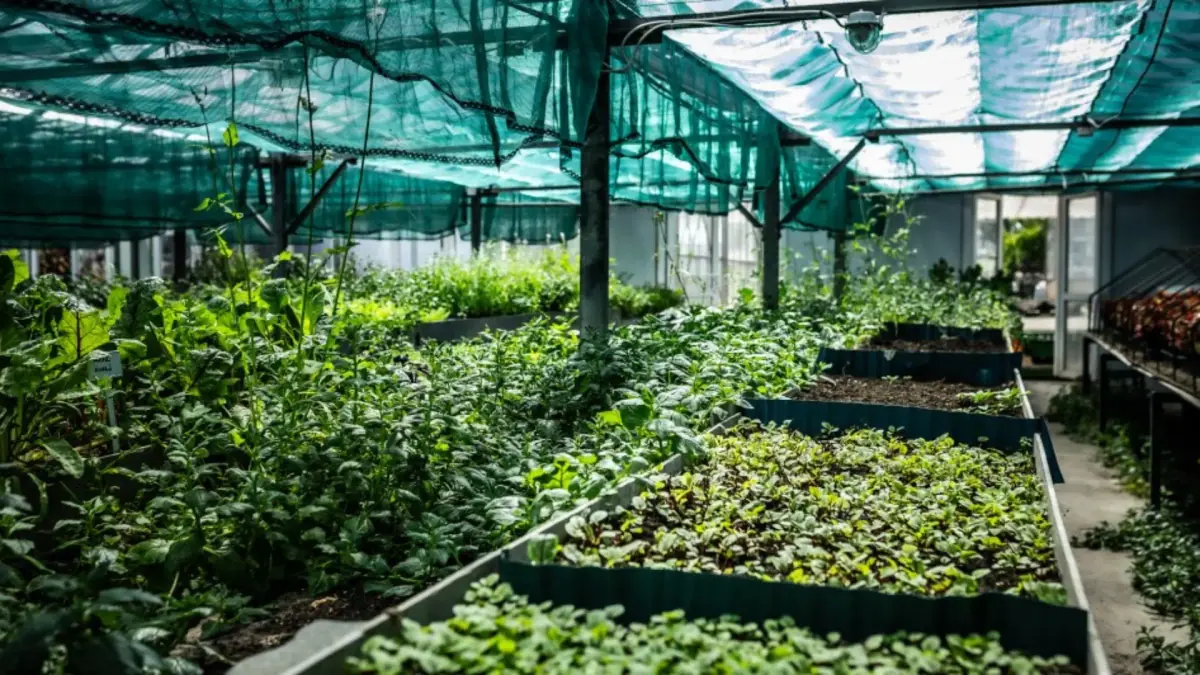
The greenhouse of Platán Gourmet, a Tata success story, truly opens up new dimensions. What you find here is not so much a kitchen garden as an inspiration laboratory.
Many Hungarian restaurants tend their own gardens, but this year the horticultural operation behind the two-Michelin-starred Platán Gourmet restaurant in Tata has undertaken a special development. It has been extended with a new, high-capacity greenhouse, an investment that allows the restaurant to become partly independent of the whims of the weather and the seasons – opening up unparalleled opportunities in fine gastronomy.
Chef Pesti István is building not just a kitchen but a gastronomic universe of its own, one that reaches far beyond the boundaries of fine dining. It is a place where the chef not only cooks, but also sows, plans and breathes in harmony with nature.
Their own garden, at their own pace
Winter and summer alike, the weather sets limits – what we expect from the greenhouse is that we will finally not be at its mercy. The garden wasn’t started because it sounds good, but because we needed things that cannot be sourced anywhere else, says Pesti István, chef of the two-Michelin-starred Platán Gourmet.
One of Hungary’s most accomplished head chefs also explains that the aim is not for the garden to meet every need – that would not be realistic. What matters far more is that it provides unique produce that gives a dish character and a story: The goal is not to grow everything. Rather, we create specific ingredients that make what we do here truly unique
Strawberries picked green, beans and squash harvested together with their flowers, tendrils or vines, matchstick-thin sprouting carrots and tender lettuce served with its roots all bring textures and dimensions of flavour that are not available any other way. According to the chef, their approach could even serve as a model. It is an unusual way of thinking: We think backwards: first the garden, then the dish.
An ever-changing menu
Platán’s garden is not a “production unit” but a space for an ongoing dialogue between the kitchen and nature. Pesti illustrates this with an example: We can order baby carrots in three sizes. But we sow them from seed and don’t thin them out – so I can pull out matchstick-thin ones and put them on the plate together with their sweet, soft root hairs, while the rest keep growing. That way I can use a different flavour and growth stage every day. These aren’t standard, ordinary vegetables you can buy from growers – they are stories
“The small experiments – such as baby corn served in its husk – are actually the greatest specialities. They aren’t necessarily ‘ingredients’ at all, but seeds of ideas: inspirations from which new dishes are born,” explains the chef. “The garden doesn’t dictate the menu; it shapes it continuously,” he adds.
The garden produces microgreens, flowers, herbs, salad leaves, squashes and many other kitchen-garden plants, partly in open ground and partly in the new greenhouse. The abundant summer harvest is also preserved by bottling, fermenting, drying and freezing, so that a distinctive range of flavours is available in winter too.
With certain flowers we use every day, if we order them from abroad, half of them are ruined by the time they arrive. It isn’t worth it. The point of the garden isn’t to grow everything, but to grow what cannot be sourced elsewhere. Not enough years have passed yet to have the land certified, but we try to use few chemicals. We don’t always succeed, but that’s the direction, adds Pesti István.
Source: Turizmus Online