
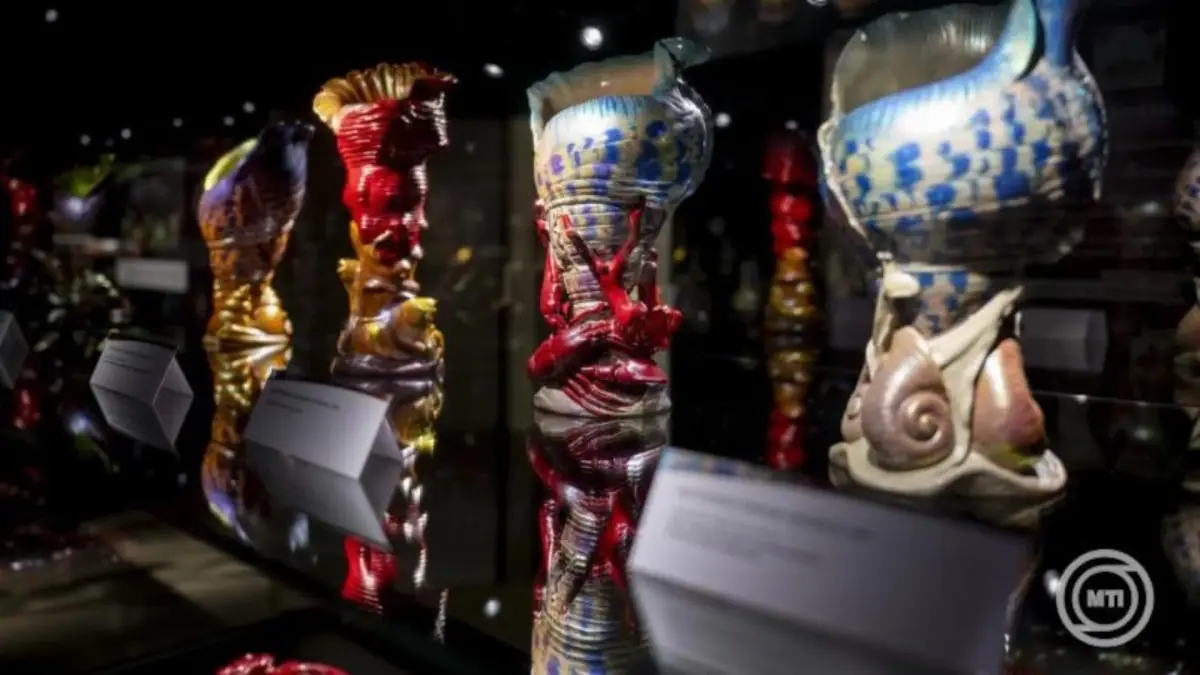
For the first time, the public can see the private Zsolnay collection that Judit Virág and István Törő have built up over three decades, on display at the Virág Judit Gallery until 19 April.
Among the nearly 120 Art Nouveau objects on display are the world's most expensive Zsolnay ceramics, said István Törő. He recalled that Miklós Zsolnay single-handedly built his factory from nothing, and within 15 years made it to the Vienna World's Fair, the pinnacle of historicism, and then to the Paris World's Fair, where he achieved his greatest success in 1900.
The collector stressed that there are very few success stories like that of the Zsolnay factory, which has 120 years of success behind it, and interest in its ceramics is still growing today.
“He is not only the greatest figure in Hungarian applied arts, but also in Hungarian industrial history (…),” he emphasised. He said that between 1891 and 1896 Miklós Zsolnay personally carried out 4,100 glaze experiments, which produced the eosin glaze that ensured the factory's worldwide success. As he added, the value of Zsolnay lies not only in its beauty but also in its rarity. The exhibition focuses on the factory's most successful period, Art Nouveau, and the objects on display include at least 15 pieces of which, as far as is currently known, no other example exists in the world.
István Törő said that after eight decades, collectors rediscovered Art Nouveau in the 1970s and 1980s, and the hunt for Zsolnay ceramics began. At first the pieces changed hands for next to nothing and made their way to Western Europe and America, as there was no demand for these valuable pieces in Hungary. The turning point came in the early 2000s, when the first affluent Hungarian Zsolnay collectors appeared and works began flowing back to Hungary. Today Zsolnay has become the world's most expensive Art Nouveau ceramic, and seventy per cent of the major collections are now in Hungary.
The Virág Judit Gallery has deliberately built itself up as the commercial centre for Zsolnay. Pieces from the manufactory regularly feature in its auctions, and last year it held its fifth dedicated Zsolnay auction, where many ceramics sold for more than one hundred thousand dollars (HUF 33.3 million).
István Törő used to collect paintings and coins, and in the early 1990s he picked up Éva Csenkey's book Art Nouveau Zsolnay Ceramics (Szecessziós Zsolnay kerámiák), which sparked his passion for Zsolnay ceramics. In 1996 he heard that a ten-piece ceramics collection was for sale, including rarities such as the Witch figure and one of the Tulip Goblets, of which only a few exist in the world. The collection had been brought from Serbia to Hungary by Judit Virág, so shortly afterwards they came to an agreement and soon opened the Mű-terem gallery on Falk Miksa utca, which later became known as the Virág Judit Gallery.
István Törő's private collection comprises several hundred Art Nouveau pieces, around one hundred and twenty of which can be seen by the public at the exhibition. The rest of the collection will be presented at further themed exhibitions in the future. Highlights include the small sculpture Scent of Roses (Rózsaillat), and the exhibition also features exceptional objects that the Zsolnay manufactory showed at the world's fairs around the turn of the century, of which only a handful were made.
Besides rare and valuable objects, the Virág Judit Gallery's new exhibition also evokes the 150-year history of the Zsolnay factory and the lives of its artists. The exhibition can be visited free of charge during opening hours, and on a few occasions with a guided tour by István Törő.
Source: MTI