
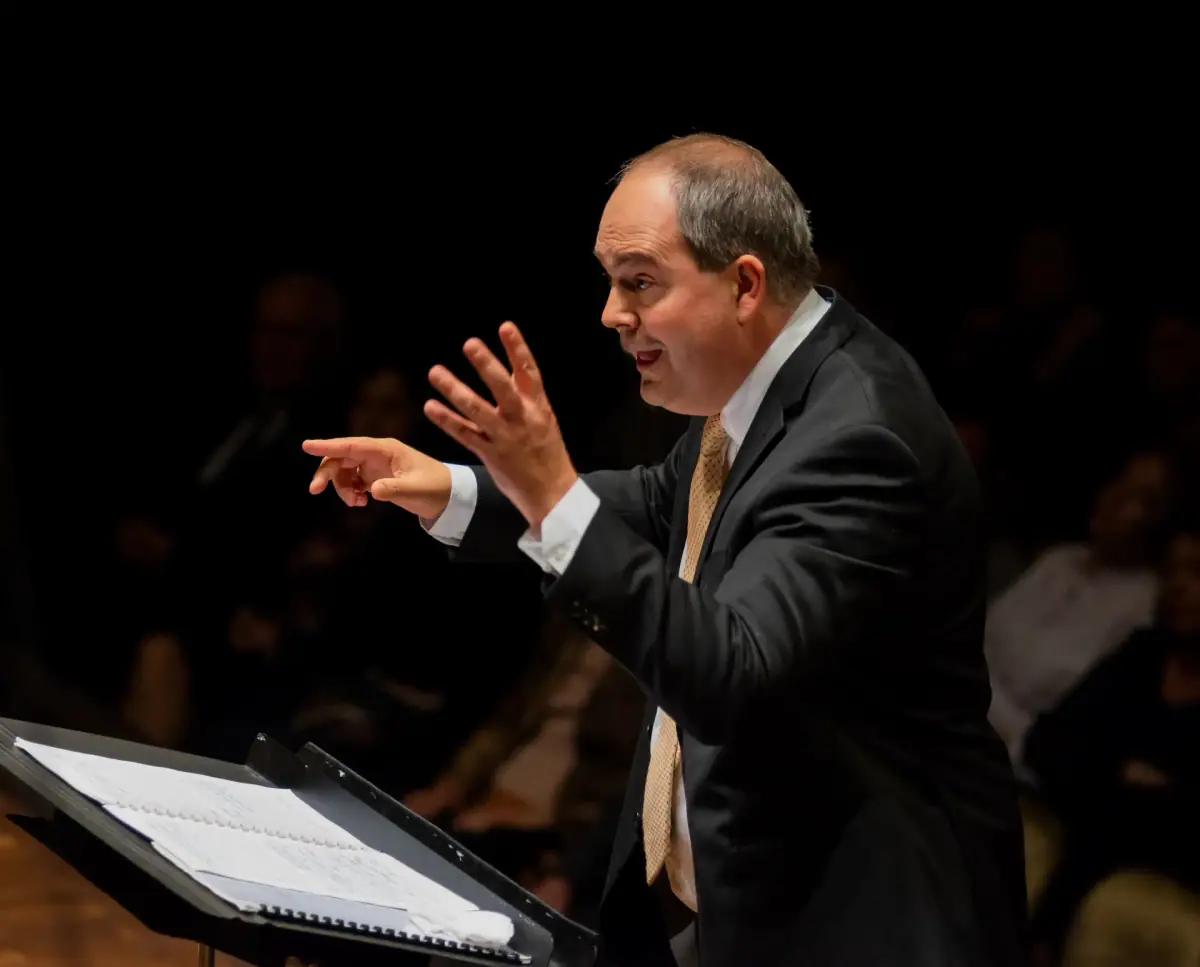
The ideas of night and transfiguration link the works performed on 20 January at the concert of the Hungarian National Philharmonic Orchestra, conducted by György Vashegyi, recently awarded the Kossuth Prize.
Mozart's Gran Partita (K. 361) is a serenade, and as we know, serenades were originally performed in days gone by on moonlit nights, as surprise music. Massenet's orchestral excerpt from an oratorio, The Last Sleep of the Virgin, envisions the Assumption of Mary with ethereal string sounds. Schönberg's string sextet, Transfigured Night, tells the story, in the language of music, of a confession that brings spiritual purification.
A quick glance at the works performed at the Hungarian National Philharmonic Orchestra's concert under Kossuth Prize-winning conductor György Vashegyi might first make us notice what appealing variety the evening's programme offers in terms of style, genre and performing forces: Viennese Classicism, French Romanticism, the Austrian fin de siècle; a serenade, an orchestral excerpt from an oratorio and an orchestral version of a string sextet – one work written predominantly for wind instruments (with a single double bass part) and two scores purely for strings. If, however, we consider the subject and mood of the pieces more closely, we may realise how delicate yet strong the threads are that link the compositions: Mozart's serenade and Schönberg's sextet are brought together by the magic of the night, while an atmosphere of elevation and transcendence is central to all three works – it is present in the third movement, the Adagio, of the Gran Partita, in the Massenet movement envisioning the Assumption of Mary, and in Schönberg's densely chromatic late-Romantic work. The third evening of the Ferencsik subscription series promises a true themed concert experience.