
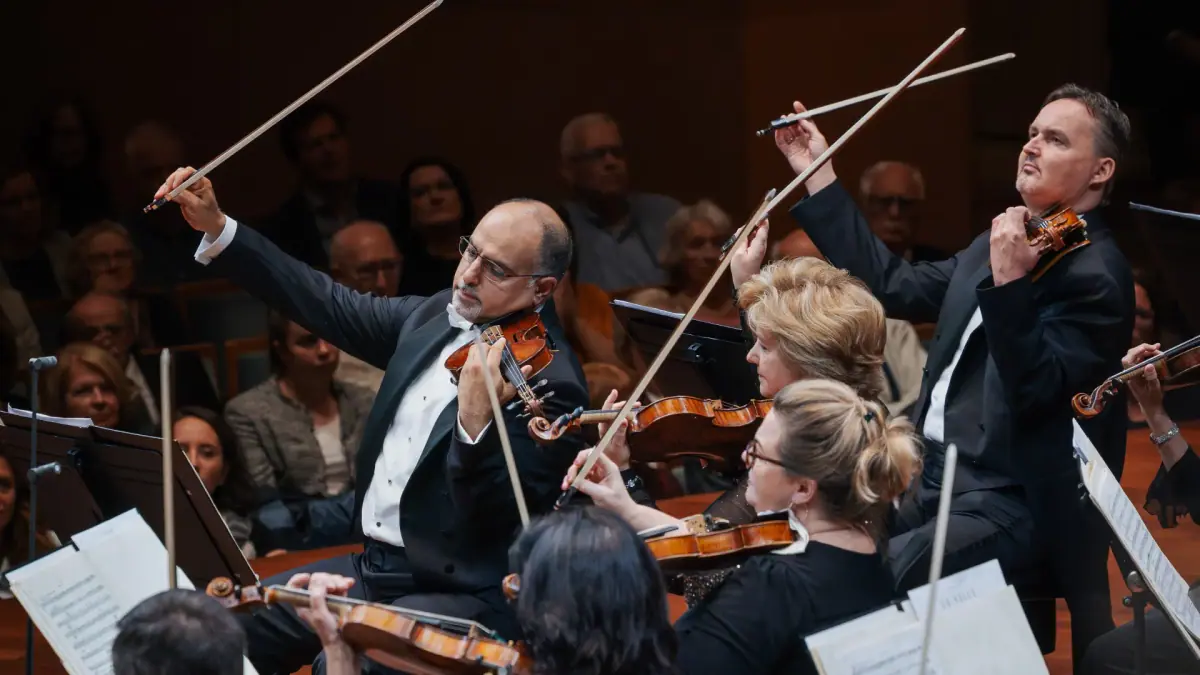
In 2026/2027, the Hungarian National Philharmonic will once again offer its concerts to audiences primarily in subscription series.
Their familiar, well-established series – the Kocsis, Opera, Ferencsik, Lukács and Pászti subscriptions, as well as the Rehearsal Room Guests (Próbatermi vendégség) concerts – on the one hand preserve their traditions, commemorating great musicians who played a defining role in the history of the orchestra and choir (Kocsis Zoltán, Ferencsik János, Lukács Ervin, Pászti Miklós), and on the other hand offer audiences the chance to explore different genres, as with the Opera subscription, which draws on the masterpieces of music theatre, and the events of Rehearsal Room Guests, built on chamber genres.
At the same time – continuing a practice as long-standing as the subscriptions themselves – every season a few non-subscription concerts are linked to especially important occasions. In 2026/2027 these include the November Kocsis Memorial Concert, marking the 10th anniversary of Kocsis Zoltán's death, and the Christmas concert, featuring spiritually uplifting works befitting the holiday.
Also recommended to audiences as a non-subscription concert is Carlo Montanaro's full-evening Rachmaninov programme in January, which promises to be superb; and finally, as always, the season closes with a non-subscription concert: Hungarian Classical Music Day (A magyar klasszikus zene napja), held every year on Kocsis Zoltán's birthday, 30 May, whose programme this time is made exciting by works by Liszt–Kocsis, Debussy–Kocsis, Dohnányi and Bartók.
As after every season, the concerts held indoors are once again joined by a delightful encore that broadens the palette: three summer evenings in Martonvásár, the Beethoven in the Open Air (Beethovennel a szabadban) series, which also highlights, with a natural gesture, the bond between the great Viennese classical composer and Hungary.
Varied venues are important to the orchestra. The four traditional venues for the indoor concerts of the season, which runs from autumn to spring, are the Béla Bartók National Concert Hall at Müpa, the Grand Hall of the Liszt Academy, the Ceremonial Hall of the Pesti Vigadó, and the Hungarian National Philharmonic's rehearsal room in the orchestra's home, Müpa. Each of the four venues has a different atmosphere, capacity, acoustics and visual setting, and most importantly, each carries a different cultural message, evoking a different tradition in the listener.
This is what they make use of when pairing genres and works with the permanent venues of each subscription: it is only natural that the large-scale Romantic and 20th-century masterpieces of the Kocsis subscription are performed in Müpa's Béla Bartók National Concert Hall, as are the Opera subscription's music-theatre favourites and discoveries, which draw large audiences; and it is equally natural that the Ferencsik subscription's programmes, featuring mainly Viennese classical masterpieces, are heard within the venerable walls of the Liszt Academy's Grand Hall, which preserve memories of music history.
Nor does it need explaining how well suited the Ceremonial Hall of the Pesti Vigadó – a space at once traditional and modern, intimate and spacious – is as a venue for the meeting of the Old and the New, of the Romantic repertoire and 20th–21st-century Hungarian music. Likewise, choral compositions and masterpieces of the oratorio repertoire also find a natural spiritual home in the Vigadó.
And if the question arises as to which venue might be ideal for the conversational chamber concerts of Rehearsal Room Guests, it is clear that these events call for a homely, informal atmosphere, and hardly any other venue could create it better than the Hungarian National Philharmonic's rehearsal room, which bears the name of Kocsis Zoltán.