
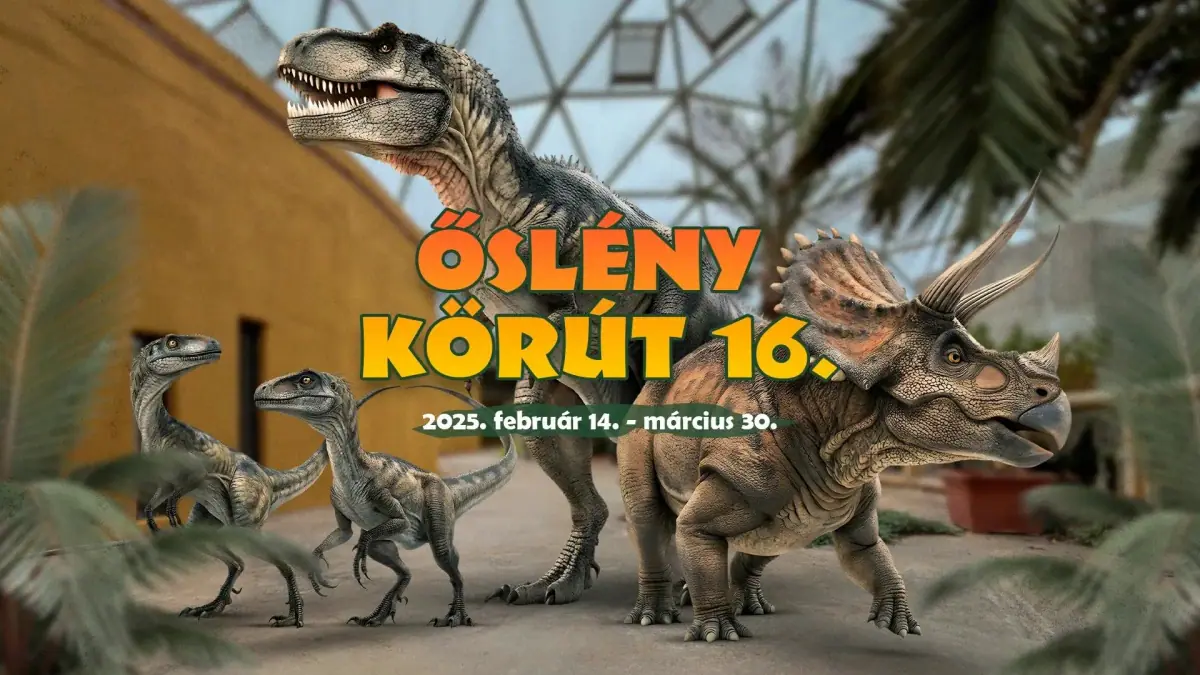
Until 30 March, the exhibition Őslény körút 16. (literally “16 Prehistoric Creature Boulevard”), set in the vast interior of the Biodóm, welcomes everyone interested in prehistoric creatures.
Ever since the British naturalist, anatomist and palaeontologist Richard Owen named a group of ancient reptiles dinosaurs, or “terrible lizards”, interest in them has never waned. This is hardly surprising, since these animals were the dominant life forms on Earth for millions of years during the Mesozoic, the middle era of Earth's geological history. Their most ancient representatives appeared at the end of the Triassic period, 233 million years ago, while the last dinosaurs died out at the end of the Cretaceous period, 65–66 million years ago – rather suddenly by geological standards.
Dinosaur remains were found even in antiquity, but the scientific study of the finds only began at the end of the 18th century. Today palaeontologists have identified around 900 different dinosaurs, and their number keeps growing with new discoveries. As more and more fossilised remains are unearthed, we are learning more and more not only about what these prehistoric creatures may have looked like, but also about how they lived, what they ate and how they cared for their young.
Meanwhile, dinosaurs have not left popular culture cold either: they inspire books, films and works of art. Among the books, the most influential were probably Arthur Conan Doyle's classic The Lost World, published in 1912, and Michael Crichton's 1990 novel Jurassic Park (first published in Hungarian under the title Őslénypark).
Dinosaur exhibitions are popular productions everywhere, as they promise interesting sights and exciting adventure for children and adults alike. These exhibitions generally present prehistoric creatures whose best-known specimens were found in the United States, Canada, Portugal, Tanzania or Australia. Few people know, however, that the name of a tiny former village in Hungary, Iharkút, is also on the list of famous dinosaur sites. While even nursery-school children can rattle off the names T-Rex, Oviraptor and Hadrosaurus without a mistake, very few have heard of Ajkaceratops, Hungarosaurus, Bakonydraco or Foxemys trabanti, even though these too are prehistoric reptiles – indeed, world-famous Hungarian prehistoric reptile finds.
At the exhibition Őslény körút 16., organised by Budapest Zoo & Botanical Garden and also featuring international material, visitors can see giant – in many cases life-size – models of the best-known dinosaurs and get a taste of the results of Hungarian dinosaur research, including material from the Iharkút excavations, made possible by the cooperation of the Hungarian Dinosaur Foundation (Magyar Dinoszaurusz Alapítvány) and the Zoo Foundation (Állatkerti Alapítvány). The leader of the excavations, Dr Attila Ősi, head of the Department of Palaeontology at ELTE, has also agreed to give talks on the excavations in Hungary at pre-announced times during the dinosaur exhibition.
The prehistoric experience is rounded off by an interactive dig and various educational programmes, as Budapest Zoo & Botanical Garden considers public education one of its key tasks. Those who see the giant reconstructions, stalk the moving model, watch the educational films, try out the palaeontology mini-playground and experience the adventures of the VR prehistoric world will be enriched not only in experience but also in knowledge. Another special feature is that, in addition to the prehistoric creatures, visitors can also encounter dragons in part of the exhibition, since the legends, beliefs and tales about them are also based on prehistoric animal bones found and misidentified before the birth of modern science.
Dates of the educational talks and further information>>
Source: zoobudapest.com