
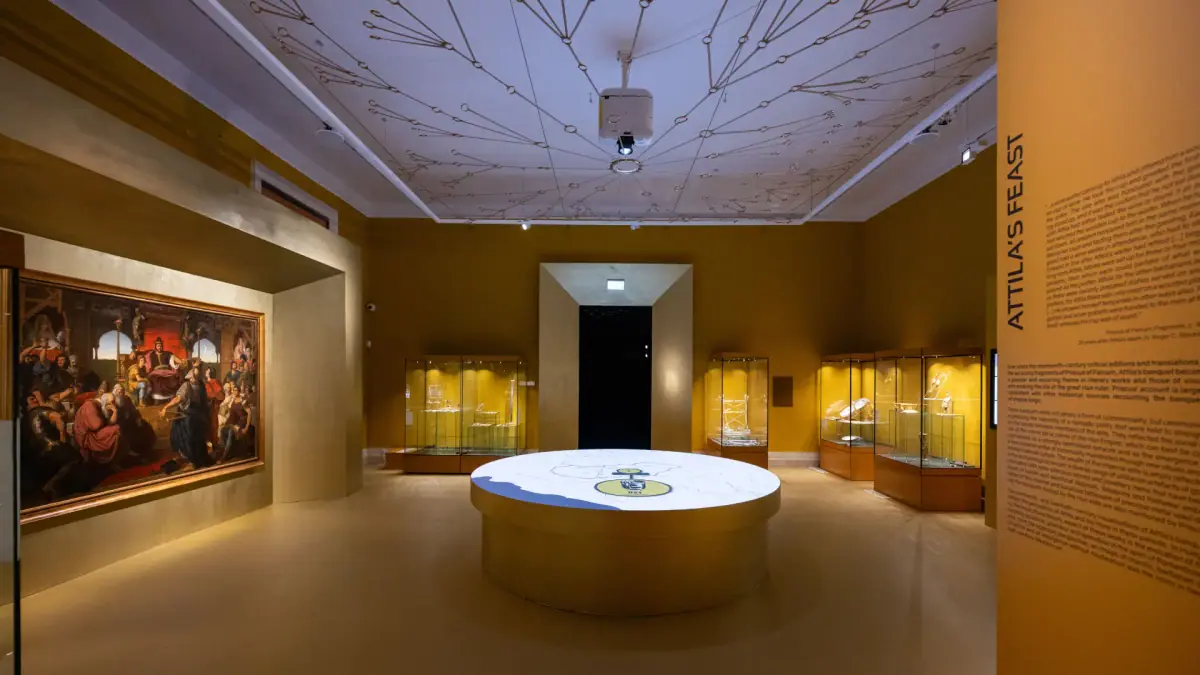
Priceless treasures, the weapons of conquerors, deformed skulls found in graves and the legendary story of the Hunnic Empire. All this in one exhibition whose protagonist is Attila, ruler of the Huns.
The temporary exhibition entitled Attila, which presents the person and legacy of the ruler of the Huns, is outstanding even by international standards. Through some 400 artefacts from 64 museums in 13 countries, the exhibition evokes the figure of Attila and his age.
For the duration of the exhibition, the Palatine Joseph Halls of the Hungarian National Museum have been completely transformed with special visual and technical solutions to evoke the memory of a bygone age. The curators have arranged the artefacts so that visitors can also discover the Western, Eastern and Hungarian interpretations that have emerged over the past 1,600 years, that is, in the ages since Attila. We can see the customs the Huns lived by, what they left behind and what influence they had on later cultures around the world.
In a unique way, the exhibition examines the relationship between the myth surrounding Attila and historical reality, in the light of findings from archaeology, history, art history, anthropology and archaeogenetics, as well as contemporary reflections. It builds a bridge between the memory of the legendary Hun ruler that lives on to this day in Eastern and Western cultures, presenting the many interpretations of the figure of the conquering ruler.
The exhibition features remarkable jewellery that has made its way into the display cases from the Carpathian Basin and other parts of the former Hunnic Empire. Among the items are bracelets, rings, necklaces, a garnet necklace, and even “Attila’s poison cup”, an electrum chalice originally decorated with glass inlays, found near Szeged-Nagyszéksós.
A diadem from an elite female burial in Azerbaijan and the grave assemblage of a high-ranking man from North Macedonia can also be seen in the Attila exhibition. Part of the Domagnano Treasure has come to Budapest from the Louvre Abu Dhabi and another part from the British Museum – interestingly, these pieces were once owned by the National Museum.
The exhibition, open until 12 July, is complemented by a rich series of accompanying events. Visitors can look forward to an international conference, academic lectures, round-table discussions, heritage-themed family and children’s programmes, museum education sessions, craft workshops, book launches, film screenings and live music.
Source: mnm.hu